Norwalk opens FY2028 budget season at joint hearing
Norwalk opened its fiscal 2028 budget season with officials warning of a $3.3 million teacher health insurance shortfall.
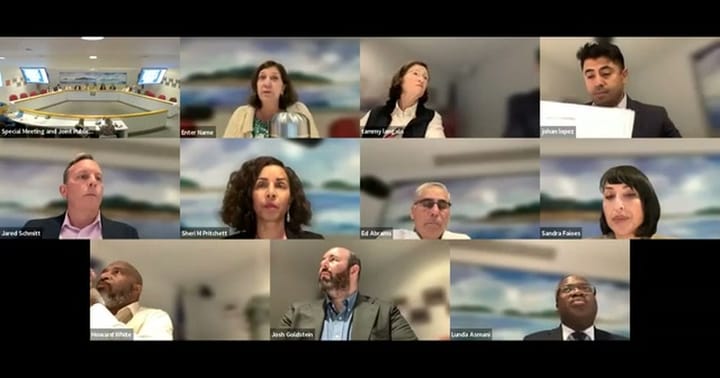
Other Committee · Meeting of September 29, 2026
Norwalk opened its fiscal 2028 budget season with officials warning of a $3.3 million teacher health insurance shortfall. City CFO Jared Schmidt said the city closed fiscal 2026 with an $800,000 surplus after using $8 million in fund balance and kept its AAA bond rating, while Board of Education CFO Linda Osmani said the insurance gap cut the district's effective funding increase to 2.8 percent from a budgeted 4.1 percent. Schmidt also flagged a new state mandate on business personal property tax that could cost the city $800,000 to $1.2 million next year.
A teachers' union speaker pushed back, saying "we are partners in Norwalk public schools, but we are not the ATM." Resident Nick Serzan warned that underfunding special education "we get sued and other things, bad things happen." No votes were taken; the hearing was informational, kicking off a calendar running through a May 13 final budget approval.
In the full story:
- Who Was There
- Organizations And Documents Referenced
- The complete report — 2,484 words
Source: the Other Committee meeting of September 29, 2026, reported from the official video recording and transcript.
The Full Article
Mayor Smith Opens FY2028 Budget Season
The hearing exists because Norwalk's charter requires an annual joint public hearing between the city and Board of Education to kick off the budget cycle, and because the city underwent a 2025 charter revision that changed several budget deadlines and processes this year is the first to follow. The question before the body Tuesday was not a vote but a presentation: lay out where the city and schools stand financially heading into fiscal 2028 and take initial public comment.
Mayor Barbara Smith, delivering her first full budget cycle as mayor after taking office January 2, framed the season around three goals: minimizing tax impact, maintaining services and preserving the city's AAA bond rating. She noted the prior budget contended with the third year of a four-year property revaluation phase-in, rising employee health care costs, and the settlement of six union contracts, and said she has pushed departments since January to look for efficiencies and new revenue "because every dollar matters." She thanked City CFO Jared Schmidt, Board of Education CFO Linda Osmani and Interim Superintendent Sandra Fayoese by name for what she called an extraordinary partnership.
Interim Superintendent Fayoese used her remarks to defend the district against what she called "past criticism" that it is administratively top-heavy, saying adjustments have made the central office "efficiently run." She cited recognition from the state, including a second consecutive invitation to a state assessment results release led by Education Commissioner Russell Tucker, a presentation to the state's Interagency Council for Ending the Achievement Gap chaired by Lieutenant Governor Susan Weisowitz, and ongoing work by Dr. Lewis on a state Blue Ribbon Committee examining the education cost-sharing funding formula. She flagged rising special education costs as a driver of budget pressure common to districts statewide: "We have students with increased needs. This is similar to other school districts in the state and across our country."
Finance Committee and Board of Education Chairs Frame the Budget Process
City council Finance and Claims Committee member Johan Lopez opened by explaining, on behalf of committee Chair Jim Frey, the structural difference between the operating budget (day-to-day costs funded mostly by property taxes) and the capital budget (long-lived projects funded through 30-year municipal bonds). He credited the late council member Greg Burnett with helping design the public-facing budget forms used in these hearings "because he really wanted to make sure the city and its residents understood the city's financial position." Lopez said communication between the city's and district's finance staffs has improved over recent budget cycles and said he evaluates budget choices using a framework aimed at "maximizing quality of life outcomes for all residents subject to budgetary constraints."
Board of Education Finance Committee Chair Sherry McCready Pritchett's remarks were brief and framing rather than numerical: she said the hearing should balance investing in students with responsible stewardship of public dollars, calling it "not always an easy balance. But it is an important one."
This section consumed roughly the first twenty minutes of the hearing and produced no numbers in dispute; it set the terms — efficiency, transparency, collaboration — that both CFOs returned to in their presentations.
City CFO Jared Schmidt: FY26 Closeout and FY27-28 Outlook
The substantive financial content began with Schmidt's walk-through of the fiscal year that ended June 30, 2026. The city is projecting an $800,000 surplus, but Schmidt noted the adopted budget had already built in the use of $8 million from the city's fund balance, so the surplus sits on top of a planned drawdown, not in place of one. The city maintained its AAA bond rating, which Schmidt said allows access to capital markets "at the lowest available interest rates."
On revenue, Schmidt said the city saw unfavorable variances in motor vehicle property taxes, attributing the miss partly to a new state-imposed methodology for valuing vehicles that the finance department had not previously worked under. Other revenue categories ran favorable: a one-time infusion from a development deal that closed in fiscal 2026 instead of the expected fiscal 2025, higher building permit revenue, and a slight dip in interest income tied to falling rates. On expenditures, Schmidt said winter storm response, including overtime and a spike in salt prices driven by regional demand, pressured the public works budget, while the resolution of six union contracts "weighed on" the overall picture.
Looking at the current fiscal 2027 year, now in its fourth month, Schmidt said a minor city hall restructuring is projected to save about $1 million annually. He said the city is managing the third year of the revaluation phase-in, a 4.1 percent increase to the Board of Education, rising health care costs, and the $3.3 million Board of Education high-deductible health plan shortfall — which he described as a shared problem between the city and the district. "There's not a lot that just structurally can be done this year, but we'll manage our budgets between us and the Board of Education to resolve this problem, but this, it's not going away," Schmidt said, adding that without a structural fix "it's going to be twice as bad next year."
For fiscal 2028, Schmidt flagged three specific cost pressures: the fourth and final year of the revaluation phase-in; continued health care cost growth; and a new unfunded state mandate changing the methodology for calculating business personal property tax, which he estimated will cost the city $800,000 to $1.2 million. He also said the city should assume a one-time state municipal grant increase will not recur "barring any additional information" from the state budget process. On the efficiency side, Schmidt reported the city has identified 2,624 improperly registered vehicles, generating about $157,000 in recovered tax revenue, and that an August tax sale — now run on a biennial basis — generated more than $6 million, matching its budget target.
Schmidt also previewed two charter-driven process changes for the capital budget: bond authorizations more than four years old will now sunset automatically unless departments request continuation (with school construction projects, which depend on delayed state reimbursements, cited as a likely candidate for continuation), and the capital planning horizon is expanding from five years to ten, with years six through ten pooled rather than itemized individually.
Board of Education CFO Linda Osmani: Enrollment, Achievement and the $3.3 Million Insurance Gap
Osmani's presentation covered enrollment, achievement and the district's own budget trajectory. As of September 1, the district employed just over 2,000 people, welcomed almost 140 new employees and more than 1,000 new K-12 students who collectively speak 48 languages. She said 93 to 94 percent of positions approved in the fiscal 2026 budget work directly in schools or in direct support of schools.
On achievement, Osmani cited a 92.5 percent average graduation rate for the most recent cohort, with the Center for Global Studies and P-TECH both reaching 100 percent graduation. She said Norwalk has outperformed state averages in English language arts, math and science, and that chronic absenteeism, while a nationwide challenge, is trending down for both high-need and non-high-need Norwalk students even as the district serves a larger high-need population than the state average. She highlighted a new districtwide International Baccalaureate program spanning kindergarten through 12th grade and an undefeated season for the Norwalk High School Marching Vanguard, culminating in state and national championships.
On construction, Osmani said students will enter Norakai and P-TECH for the first time this fall, following last year's opening of Dr. Ruby Shaw School in South Norwalk. The district's next major project, West Rocks Middle School, will file state paperwork this summer; Osmani said delaying that filing by a year raised the anticipated state reimbursement rate to 65 percent from 60 percent, calling it "worth the wait."
The budget numbers were the heart of her presentation. The approved fiscal 2026 budget was just over $233 million; fiscal 2027's $242 million budget represented a nominal 4 percent increase from the mayor's recommendation, which the city council raised to 4.5 percent, plus an additional $2 million for health insurance, bringing total new investment to 5.9 percent. A late $1.95 million state grant allowed the local budget to be funded at 4.1 percent while still providing some tax relief. Osmani said the district is assuming that $1.95 million in state funding will continue into fiscal 2028 and will not need to be replaced with local dollars. But the $3.3 million unbudgeted health insurance increase reduced the district's effective year-over-year gain to 2.8 percent. "We began the year with a 4.1 percent increase on the local side, accounting for that increase, the Board of Ed truly has 2.8 percent year over year," Osmani said. She added that special education pressures continue, including funding for a program called Momentum serving students with externalizing behaviors who are now moving from middle school into high school, and said a fifth-grade expansion at Dr. Ruby Shaw School will require additional resources next year.
Public Hearing: Operating Budget Comments
Four speakers addressed the operating budget. Resident Nick Serzan, who said he has three children in Norwalk schools, argued the district cannot responsibly cut special education or multilingual staffing. "So if we don't give the proper resources, what ends up happening, as you probably know better than I do, we get sued and other things, bad things happen as a result of that," he said, also noting rising fuel costs and teacher health insurance pressures as unavoidable expenses.
Resident Marcus Heimich, identifying himself as the parent of a special needs student, asked for more preventive measures, including additional Orton-Gillingham-trained staff, to avoid costly out-of-district placements. "If we are going to cut special education, what are we going to do to make sure that students are keeping up?" he asked, saying some Norwalk students are "falling through the cracks."
Resident Diane Loricello, a frequent commenter at these hearings, repeated budget suggestions she said she has raised in prior years without action: adding a "want versus need" column to departmental budget forms, expanding use of clean energy including solar on municipal and school buildings, merging the city's and district's solid waste and recycling contracts, and publishing an accounting of fuel use by energy type.
A speaker identified on the call during the online portion of the hearing as representing Norwalk teachers — rendered in the broadcast as "Yordan" — pushed back specifically on the $3.3 million insurance assumption, saying the district built its budget on an insurance plan change the union never agreed to. "Why was the budget built on an assumption that teachers would move to an insurance change that we had neither negotiated nor agreed to? We should not be expected to absorb the cost of a budget assumption that we did not make," the speaker said, noting that in 2023 teachers had already moved to a high-deductible plan that saved the district more than $4 million, and that a teacher vote this year rejected switching to the state partnership plan because it would not produce meaningful savings. "We are partners in Norwalk public schools, but we are not the ATM," the speaker said.
Public Hearing: Capital Budget Comments
Only Loricello spoke on the capital budget. She credited the city and Department of Public Works for sidewalk and ADA-compliant corner improvements, said the Planning and Zoning Commission's review role should be expanded beyond the Plan of Conservation and Development, and renewed criticism of the siting and cost of the Dr. Ruby Shaw School project, which she said required additional property purchases and flood-resilience work. She also asked for more solar installations on fire stations and other municipal roofs, more artificial turf soccer fields at sites including Taylor Farm and Cranberry Park, and suggested the city explore corporate sponsorships, with naming rights, to offset capital costs. No other speakers addressed the capital budget, in chambers or online, and Mayor Smith closed both public hearings and adjourned the meeting without a formal vote.
Procedural steps and outcome: No motions were made and no votes were taken at this hearing; it was structured entirely as informational presentations followed by public comment. The city's charter-mandated calendar continues with a public comment session January 14, the mayor's recommended budget due February 5, a Board of Estimate and Taxation hearing tentatively set for March 24, and final budget approval due May 13 — about a week later than the prior cycle under the revised charter.
Mayor Barbara Smith — presided over the hearing and gave opening remarks. Interim Superintendent Sandra Fayoese — gave remarks on district performance and funding; name rendered variously in the broadcast (also heard as Baowies, Fayoese, Faylis, Fayaways). City Chief Financial Officer Jared Schmidt — presented the city's financial status and outlook. Board of Education Chief Financial Officer Linda Osmani — presented the district's financial status and outlook. Board of Education Finance Committee Chair Sherry McCready Pritchett — gave opening remarks (also heard as Sherry Pritchett). Finance and Claims Committee member Johan Lopez — gave opening remarks on behalf of committee Chair Jim Frey. BET Chair Ed Abrams — attended; did not give lengthy remarks in the transcript. Planning and Zoning Commission representative Tanya Regalas — introduced at roll call. Board of Education President Howard White — introduced at roll call. City Council President Josh Wilson — introduced at roll call. Public commenters: Nick Serzan, resident of 1 Jean Avenue, parent of three district students; Marcus Heimich, resident of 23 Surrey Drive, parent of a special needs student; Diane Loricello, resident, recurring budget commenter, spoke on both operating and capital budgets; a speaker identified on the call as representing Norwalk teachers, rendered as "Yordan" in the broadcast, addressing the operating budget.
AFT Connecticut — teachers' union affiliate cited by the teacher speaker as having been engaged, along with an insurance consultant, to research alternative health plans. Connecticut Interagency Council for Ending the Achievement Gap — cited by Interim Superintendent Fayoese as a body she presented to, chaired by the Lieutenant Governor. Connecticut Commissioner's Roundtable for Family and Community Engagement in Education — cited by Fayoese as a group the district addressed recently. Blue Ribbon Committee (state education cost-sharing formula review) — cited by Fayoese as a body Dr. Lewis sits on. Maritime Aquarium — cited by Osmani as a partner in the district's marine science pathway program. 2025 charter revision — cited by Schmidt as the source of new budget rules discussed, including dual spending caps for the city and Board of Education, bond-authorization sunset dates, and the expanded 10-year capital plan. Fiscal 2026-29 teacher contract — cited by the teacher speaker as the three-year agreement ratified before the district later asked teachers to consider changing insurance plans. Momentum program — Board of Education in-house special education program for students with externalizing behaviors, cited by Osmani as a funding priority for fiscal 2028.
Share this story
Know someone in Norwalk who follows town government? Share Townbrief Norwalk: they can sign up free.