Panel approves ADA plan, health records contract
The Norwalk Community Services Committee voted 4-0 to accept a 16-year, roughly $10 million ADA transition plan and to approve a $150,457.63 contract with Patagonia Health Inc. for a new health department records system.
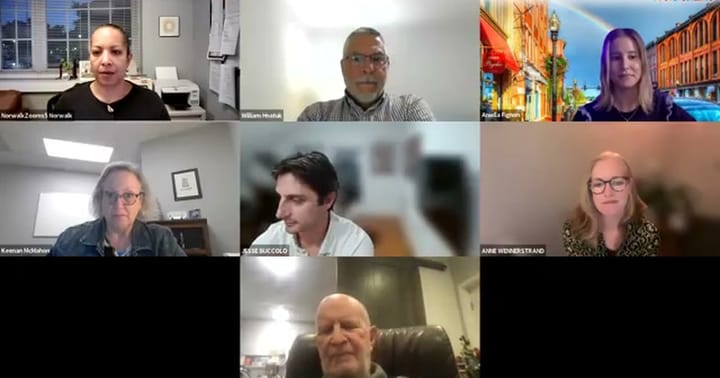
Other Committee · Meeting of September 23, 2026
NORWALK — The Norwalk Community Services Committee voted 4-0 to accept a 16-year, roughly $10 million ADA transition plan and to approve a $150,457.63 contract with Patagonia Health Inc. for a new health department records system. WT Group AEC, hired by the Western Connecticut Council of Governments, audited 54 city sites and rated City Hall 72 percent accessible, the library 83 percent, and Calf Pasture Beach 90 percent. ADA Coordinator Bill said the city has funded a dedicated ADA capital budget line since 2013, citing a $72,000 senior center courtyard grant paired with new ramp funding as an example.
Health Department staff said the new records system's annual cost will roughly double, from about $16,000 to about $34,000, citing improved insurance billing as the main benefit. "Stresses becoming the kind of the busy body," Bill said of his coordination role across departments.
In the full story:
- Who Was There
- Organizations And Documents Referenced
- The complete report — 1,983 words
Source: the Other Committee meeting of September 23, 2026, reported from the official video recording and transcript.
The Full Article
Acceptance of Minutes and Public Comment
The committee's acceptance of the prior meeting's minutes passed on a divided voice vote, with council members Anne Wenestrand and Jan Degenshine voting in favor and two members abstaining, one of whom said she had not attended the prior meeting. No members of the public had signed up to speak by the noon deadline, so the public comment period produced no speakers.
Electronic Health Record Software Agreement with Patagonia Health
Background and stakes: The Norwalk Health Department has used its current electronic health record system for more than 15 years. With the system aging and the department managing over 56,000 patient records and more than 25 regular users, the department issued RFP 4478 in cooperation with the city's purchasing and IT departments to solicit a replacement.
The question before the body: Whether to authorize Mayor Barbara C. Smith to sign a three-year agreement with Patagonia Health Inc., execute related implementing documents, and issue two one-year contract extensions for years four and five.
Substantive content: Health Department staffer Deanna D'Amour and project coordinator Aniela Fignon told the committee the department logged about 2,300 patient visits in 2024 through programs including childhood, adult and travel immunization clinics, large-scale community vaccine clinics, sexual health services and tuberculosis prevention activities. The RFP sought enhanced data security, HIPAA-aligned regulatory compliance, a patient portal, improved insurance billing capability, and enhanced reporting tools. A selection committee drawn from the health and IT departments, including the clinical services supervisor, an advanced-practice nurse, the health operations manager, the medical biller, the public health program associate and the directors of IT and health, chose Patagonia Health for its public-health-specific design, integrated billing-to-records workflow, built-in data-sharing connections with the state and labs, and customer service reputation.
The three linked authorizations were: item 1a, a three-year agreement not to exceed $150,457.63; item 1b, authority to execute related amendments and instruments; and item 1c, two one-year extensions, listed in the agenda reading as $34,508.58 for year four and an amount read aloud as "thirty-five thousand eight and eighty-eight dollars and ninety-two cents" for year five, which the committee treated as approximately $35,808.92. Fignon said the department's current annual licensing cost of about $16,000 will roughly double to about $34,000 once the new system is implemented, with first-year development costs covered through state per-capita grant funding — about $200,000 annually — that the department also uses for staffing support and pilot projects.
The deliberation: The committee's presiding member asked how the new pricing compared with the prior system and whether other Connecticut municipalities use Patagonia Health; Fignon confirmed other Connecticut local health departments use the vendor, citing that familiarity as a selection factor. Degenshine asked whether the increased annual fee, once grant funding for implementation lapses, would be absorbed into the existing IT operating budget line; Fignon said the current licensing fee is already budgeted in IT and that a grant account would serve as a fallback. Bailey, participating by phone while driving, asked about the size of the annual per-capita grant and pressed on what justified roughly doubling the cost.
"What's the, I think, the one or two biggest benefits that would justify this or increased in doubling the cost?" — Councilmember Bailey.
Fignon responded that the integrated insurance billing and revenue-capture feature was the primary justification, noting the department currently relies on separate systems and substantial staff labor to process insurance billing.
Procedural steps and outcome: After discussion, the chair asked whether a new motion was needed; a member noted the item had already been moved for discussion earlier, and the committee proceeded directly to a vote. All four members present voted in favor, approving items 1a, 1b and 1c together.
Implications and what is next: The contract moves to the full Common Council for final authorization of Mayor Smith's signature. Once implemented, the health department's annual software cost will roughly double from about $16,000 to about $34,000, a cost increase that will shift from grant funding to the city's IT operating budget in future years absent continued grant support.
ADA Access Audit and Transition Plan
Background and stakes: Norwalk has had a dedicated ADA transition plan since 2013 and has funded an ADA capital improvement budget line every year since then. The Western Connecticut Council of Governments (WestCOG) secured grant funding in 2023 to update transition plans for municipalities within its jurisdiction, including Norwalk, prompting this new audit.
The question before the body: Whether to accept the final ADA Access Audit and Transition Plan Final Report (dated May 8, 2026) and the ADA Program and Policy Report (dated May 6, 2026), and direct city staff to implement the consultants' recommendations.
Substantive content: WT Group AEC, retained by WestCOG, audited every existing Norwalk facility and park — 54 sites in total, each with its own site report — against the federal 2010 ADA Standards for Accessible Design and the Connecticut State Building Code, which exceeds federal minimums in areas such as accessible parking stall and access-aisle sizing and use of a dynamic wheelchair-accessible icon. New construction completed between January 26, 1992, and March 14, 2012, must meet the 1991 standards; anything built after March 15, 2012, must meet the 2010 standards. WT Group accessibility practice lead John McGovern said the standards have changed substantively only once in 36 years.
The consultants estimated phase one through three retrofit costs at "a little over $10 million," projected across a 16-year implementation timeline. An additional roughly $2.3 million in "smart practice" improvements — upgrades that exceed minimum enforceable requirements — were identified, along with just under $1.8 million in sites the consultants recommended leaving as-is because equivalent accessible options exist elsewhere, consistent with Department of Justice guidance on recurring-site "program access."
Community engagement included an online survey that drew 31 responses and two public sessions: an open meeting that drew a single attendee, and a session with the city's ADA Advisory Committee held June 4, 2025. Project manager Tatum Story initially told the committee that 21 of 31 survey respondents, or 75 percent, reported disability prevalence, then later in the same discussion cited a figure of 28 of 31 respondents; the transcript does not resolve which figure is accurate. Among facilities respondents rated on a one-to-three accessibility scale, City Hall scored 72 percent, the Norwalk Public Library scored 83 percent, and Calf Pasture Beach, the most-visited park among respondents, scored 90 percent. Websites, public right-of-way assets such as sidewalks and signals, and school buildings were outside this project's scope, though the Parks and Recreation Department separately reviewed playgrounds on school property.
The deliberation: Degenshine, who disclosed she was the single attendee at the in-person public meeting and later joined an ADA transition committee at the Coordinator's invitation, asked what substantively changed between the 1991 and 2010 standards. McGovern and Story explained that reach-range limits for wall-mounted devices such as light switches dropped from 54 inches (reachable by side approach) to 48 inches (forward approach only) after the Department of Justice found many designers were defaulting to the higher measurement, and that outdoor recreation assets — playgrounds, sports fields and courts, boating and fishing facilities — were added to the standards for the first time in 2010. A newer committee member asked how implementation would be overseen across departments and how transition-plan costs might be coordinated with the city's capital improvement schedule; McGovern recommended blending the transition plan with capital planning rather than treating it as a standalone document, noting many line items carry no cost and can proceed regardless of budget constraints.
"We would encourage the city not to silo the transition plan. the city has many other plans. Blending this with your capital improvement plan might show you efficiencies." — John McGovern, WT Group AEC.
ADA Coordinator Bill described how his position, created in 2013 and funded through a dedicated citywide ADA capital line rather than individual department budgets, allows him to coordinate across departments. He cited a senior center courtyard renovation funded by a $72,000 grant, where his office added funding for an accessible ramp and power door openers after noticing the courtyard lacked an accessible route.
"If they hadn't been doing the courtyard this year, then we wouldn't have been doing a ramp this year, but recognizing the need and moving on that now is how you prioritize those projects." — Bill, ADA Coordinator.
Asked how he tracks ongoing projects across departments, Bill said he relies on informal relationships built over years with contacts in public works, property management, the library and police and fire departments, and said he hopes to formalize a quarterly check-in system with a designated ADA contact in each department.
Procedural steps and outcome: After questions concluded, the committee voted, with all four members in favor, to accept both reports and direct staff to implement the recommendations.
Implications and what is next: The report and its cost estimates move forward as a planning document; no specific dollar amount was appropriated at this meeting beyond acceptance of the report itself. Future capital budget requests tied to the plan's roughly $10 million in phased retrofits, $2.3 million in smart-practice upgrades, and ongoing project-by-project coordination (such as the senior center ramp) will surface in future city budget cycles.
Adjournment
The committee adjourned on a motion by Wenestrand with no further business, after the chair and staff liaison Julie thanked ADA Coordinator Bill and health department staffer Keena McMahon for their work.
Council member Brian Bailey — participated by phone. Council member Anne Wenestrand (also referenced in the transcript as "Winestrand"). Council member Jan Degenshine. A fourth committee member, addressed in the meeting only as "Jesse," who presided over the meeting and called votes. Julie — staff liaison who introduced department presenters; no title stated in the transcript. Keena McMahon (also referenced as "Keenan") — described as leading the Health Department team present; no title stated in the transcript. Deanna D'Amour — Health Department staff who summarized the RFP process. Aniela Fignon (also referenced in the transcript as "Danella Fignon") — project coordinator, Health Department. Bill — City ADA Coordinator; the transcript renders his surname inconsistently as LeTuck, Natick and Hnadek. John McGovern — accessibility practice lead, WT Group AEC, consultant retained by WestCOG. Tatum Story — project manager for Norwalk's ADA transition plan and a principal with WT Group's accessibility practice. Mike Wilson — Western Connecticut Council of Governments (WestCOG) point of contact, briefly joined the meeting. Lamon Daniels — mentioned once as someone city/consultant staff had interacted with; role unclear from the transcript.
Patagonia Health Inc. — vendor selected through RFP 4478 to supply the city's new electronic health record and practice management system. WT Group AEC — consulting firm retained by WestCOG to audit 54 Norwalk sites and prepare the ADA transition plan and final report. Western Connecticut Council of Governments (WestCOG) — regional body that secured grant funding in 2023 to fund updated ADA transition plans for member municipalities, including Norwalk. U.S. Department of Justice / Title II regulations — cited by WT Group as the legal source for required transition-plan elements (barrier identification, remediation method, schedule, responsible official) and for program-access guidance on recurring sites. 2010 ADA Standards for Accessible Design and 1991 ADA Standards — the two federal design standards against which Norwalk sites were audited, with applicability determined by construction date. Connecticut State Building Code — cited as exceeding federal minimums in areas such as accessible parking stall and aisle sizing. BlueDag — cloud-based software WT Group used to conduct and document on-site accessibility evaluations. ADA Access Audit and Transition Plan Final Report (May 8, 2026) and ADA Program and Policy Report (May 6, 2026) — the two documents the committee voted to accept. RFP 4478 — the city's request for proposals for the electronic health record software solution.
Share this story
Know someone in Norwalk who follows town government? Share Townbrief Norwalk: they can sign up free.